


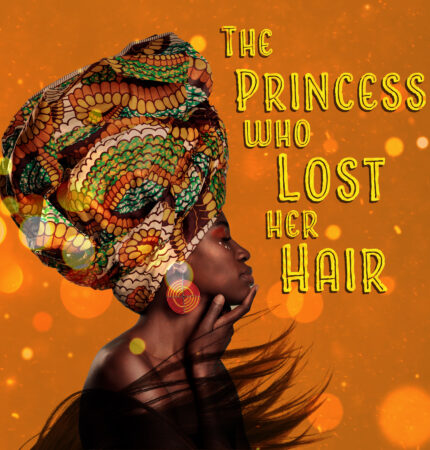
The Princess Who Lost Her Hair Play Guide
WHAT TO KNOW BEFORE THE SHOW!
PLOT SYNOPSIS

Our story begins when a chatty Weaver Bird swoops in to tell us about a time when Africa is dry, the rain has vanished, and a big lesson is about to unfold.
In the bustling marketplace, we meet Muoma, a kind beggar boy who believes his job is helping people slow down, smile, and breathe. But everyone else is in a rush including Mutu, the flustered servant of Princess Kalendi. Kalendi is famous for her long, shining hair that she believes shows her power. When the Weaver Bird politely asks for a few strands of the princess’s hair for his nest, Kalendi refuses and the bird warns her that the drought might take her hair with it.
Soon a swirling dust storm rises up, and Princess Kalendi’s hair disappears! The people panic, the drought worsens, and the princess hides away in shame. The bird then explains that Princess Kalendi will only get her hair back once she learns to become selfless, kind, and no longer think only of herself.
Determined to help the Princess and the village, Muoma sets off on a journey to find the Weaver Bird’s nest. Along the way, he shares his food with ants, saves a tiny flower, and helps a worried mouse—never knowing each challenge is actually a secret test. Because of his kindness, the Weaver Bird rewards him with a magical seed, one that can grow a tree strong enough to restore the princess and help save the village.
Muoma plants the seed in the royal garden. Princess Kalendi discovers the little tree growing against all odds during the drought. She begins to care for it in the quiet of night. And as the tree grows, so does her heart. Little by little, Kalendi becomes kinder, braver, and more honest. When the tree finally bursts into bloom, the rain returns, her hair grows back, and the land turns green again.
At last, Kalendi gives the Weaver Bird strands of her hair. She then thanks Muoma for his courage and invites him to help lead the kingdom.
PLAY BEFORE THE PLAY
ORAL TRADITION TELEPHONE
The Princess Who Lost Her Hair is an Akamba legend that has been told orally for many generations. In this activity, students will get the chance to explore oral tradition. Instruct your students to sit in a circle and have them repeat “oral tradition” three times, then break it down. “Oral” means by word of mouth, meaning something spoken, not written. “Tradition” refers to customs or beliefs that are repeated across generations.
Start by asking the class, “What makes a good storyteller?” Maybe they like a storyteller’s use of loud, dramatic voices and expressive gestures or that they have a good memory. Once the class explores what makes a good storyteller, tell your students that they’re going to try an experiment. They’re going to see what happens when our community tries to tell a part of a story by playing a game called “Telephone.”

Explain to your students that they should listen to what is whispered in their ear then repeat it quietly to the person beside them. At the same time, students will also pass a perfectly shaped ball of playdough around the circle. The playdough will represent the story. The person holding the dough will listen to what is whispered in their ear then pass the playdough to their neighbor when it’s their turn to whisper the message. While listening, if a student feels they changed the story at all or were confused about what they heard, they should press gently on the dough.
To officially start the game, hand the ball of playdough to the first student and whisper the following line from The Princess Who Lost Her Hair to them:
“The vain princess did not share a strand of her hair to build the bird’s nest, and so a drought was brought to the land.”
The student will then pass the playdough to their neighbor before whispering the phrase in their ear. Once the message and playdough have traveled around the entire circle, have the last person stand and share what they heard while showing off the ball of playdough to see how it has changed.
As a group, compare the final sentence to the original. What changed in our playdough/phrase? What stayed the same? Was it hard to keep the story the same? Do we think this would be easier if one person or a small group of people told the story?
Lastly, reflect on how important it is to preserve stories. If a story was very special and important to our community and we really wanted to remember it, what are some things we can do to ensure the story is remembered?
KAS: TH:Cn11.2.4.a; TH:Cr2.1.1
LESSONS OF AFRICA
In this activity, students will learn about African proverbs. Explain to your class that proverbs are, typically, brief sentences that give a piece of wisdom or a lesson. Divide your students into five small groups. Provide each group with a popular African proverb from the list below:

- A patient man will eat ripe fruit.
- If you want to go fast, go alone. If you want to go far, go with others.
- Only a fool tests the depth of a river with both feet.
- If you are on the road to nowhere, find another road.
- If a tree does not know how to dance, the wind will teach it.
- A child who is not embraced by the village will burn it down to feel its warmth.
- When two elephants fight, it is the grass that suffers.
- It takes a village.
Each group will work together to determine the underlying meaning of the proverb. Once the students have discussed the moral/lesson, have each group create a short scene that shows the proverb in action. Encourage the students to express their understanding of their group’s proverb within the dialogue and action of the scene. Once students have had time to prepare, allow them to perform their skit for the class and discuss the meaning of the proverb.
KAS: TH:Cn10.1.5; TH:Cn11.2.2.a
EMPATHY = A CHAIN REACTION
A main theme of LCT’s production of The Princess Who Lost Her Hair is extending kindness to others. In this activity, students will create a visual to show how kindness can spark a chain reaction. You will need the following materials:
- Construction Paper (assorted colors)
- Scissors
- Writing Utensils
- Tape, Glue, or Stapler
Start by having your students cut strips of construction paper about 12 inches long. As they cut, discuss what kindness is and how it makes your students feel. Engage with them about examples of kind things they have done or experienced, then have them write their examples on the strips of paper, one kind experience per stip. Once all the strips have something kind on them, link the strips together into a paper chain using glue, tape, or a stapler.
As you link the chain, talk with your students about how kindness creates a chain reaction. Kindness builds into more acts of kindness because when we make others feel good, we feel good, too. As the story says, “to heal oneself, one must often heal others.” Hang the paper chain around your classroom and ask your students to discuss ways they can bring kindness into their community. As they complete these acts of kindness, more links can be added to the chain.
KAS: VA:Cr1.1.5; VA:Cn10.1.2
A ROYAL WORD SEARCH
Click the link below and print off the Princess Who Lost Her Hair-themed word search (and answer key) for each of your students!
KAS: RF.K.1.b; RF.2.3.
CONTEXTUAL ARTICLE
GENERATIONAL STORIES: THE PRACTICE OF ORAL TRADITION

Tololwa Mollel, the original author of The Princess Who Lost Her Hair, was deeply rooted in the oral tradition of his childhood. He grew up in Arusha, Tanzania, in East Africa, on his grandparents’ coffee farm. He was raised surrounded by a culture rich in fables, wisdom, and community. His grandparents highlighted the importance of education and community from an early age. They often told him stories that had been passed down to them from many previous generations. Mollel notes that these early storytelling sessions are what sparked his love for storytelling, or as he calls it, “feasting on words, ” which he uses to describe his passion for oral tradition.
Oral tradition is the passing of knowledge from one generation to the next through spoken word rather than written record-keeping. Mollel decided that he wanted children around the world to experience the rich oral tradition of his community and share the love of these stories through children’s books. He began to capture these stories through various picture books, hoping to have a written version to immortalize them. He is now the author of 20 children’s books, many of which tell stories from his childhood.
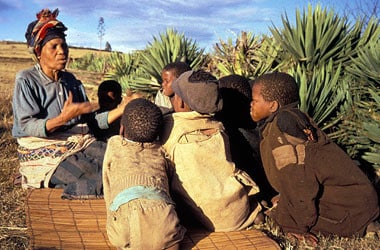
Oral tradition is a critical form of preserving a culture’s history and traditions. Across Africa, oral tradition includes proverbs, folktales, songs, dances, medicine, religious practices, and cultural sayings that teach lessons about life, social systems, and religion. The oldest generation, known as the elders, are responsible for sharing this information with the next generation as they are seen as the most knowledgeable within the group, having gained information over a lifetime. These individuals are often referred to as “living libraries.” Because they provide a group of people with wisdom, ancestral knowledge, and history. They often share tales, myths, and legends with the youngest generation to teach them morals, ethics, and community values such as bravery, respect, and the importance of consequences. Elders also serve in leadership, guiding conflict resolution and decision-making within the community. Arguably, the most crucial role of elders and the practice of oral traditions is to ensure the continuation of culture by maintaining traditions and social structures.
Thanks to the practice of oral traditions within African communities, and to authors such as Mollel who cherish African folklore, these values and stories can be passed down to many future generations, preserving the ancestral knowledge and culture.
HOW TO GROW AFTER THE SHOW!
EXTEND THE EXPERIENCE
MUOMA’S KINDNESS QUEST
In The Princess Who Lost Her Hair, Muoma embarks on a journey to find the Weaver Bird’s nest, all the while spreading kindness wherever he goes. For this activity, your students will get to go on a quest of their own. Start by breaking your class into small groups and have each group design a section of an obstacle course. Encourage them to think creatively about how to safely use chairs, tables, tape lines, or other objects found in the classroom to represent a part of Muoma’s journey to the Weaver Bird. Each group should also create one or two tasks of kindness to complete during their section of the course. If your students need inspiration, ask them to think about Muoma’s experience on his journey where he shared food with ants and helped a mouse in need.
Once each group has designed their section and settled on their tasks, have them construct their portion of the course. Then allow each group to walk their classmates through their portion of the course giving instructions about how to navigate the obstacles and complete the given tasks. Once every group has shared, the race through the course can begin! Once students complete the course, they each earn a “seed”—this could be an actual seed, a jellybean, a paperclip, or a small object that represents the beginning of their own kindness tree.
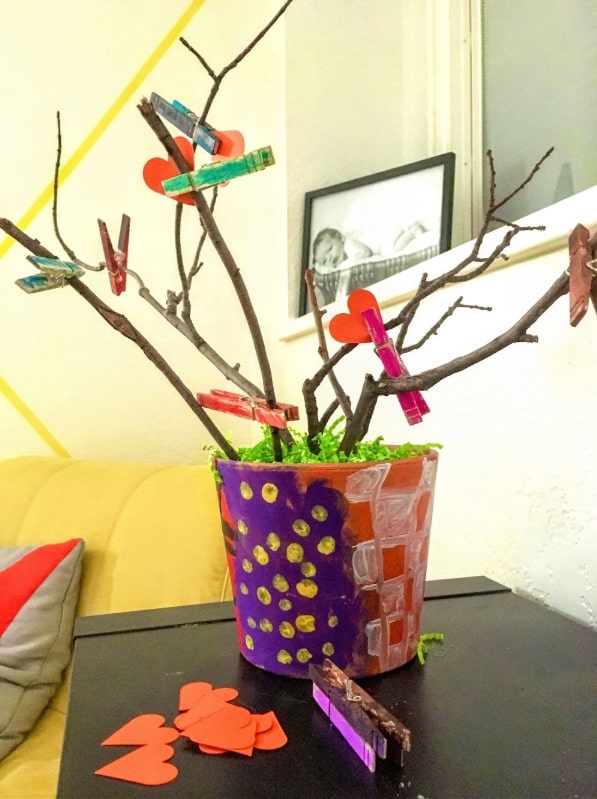
After every receives their seed, they’ll get to craft their own Kindness Tree (you can also save time and supplies by making one large tree for the whole class). You will need the following materials for your students:
Flower pot
Floral foam
Hot glue
Small sticks or small branches (Note: sticks should be thin enough for a clothespin to close entirely and still hold the paper hearts)
Clothespins
Paint, markers, or decorative items of choice
Paint brushes
Paper confetti or rocks (to fill the flowerpot)
Paper hearts
String or ribbon
Writing Utensils
Begin by having your students paint or decorate their flowerpot. While the pot is drying, students should write on and decorate each clothespin. Ask them to write a moment when they were kind or noticed someone else being kind. These clothespins will represent the acts of kindness they’ve done. Then have students cut out paper hearts using a craft punch or by hand. Decorate and write on each heart a moment of kindness, the impact of a kind act, or why kindness matters. Hearts show the “fruit” of our actions.
Once the flowerpot is dry, attach the floral foam inside with hot glue. Arrange the sticks or branches in the floral foam at different heights and angles, leaving space to attach the clothespins and hang the hearts. Fill the remaining space in the pot with paper confetti, rocks, or other filler to secure the branches. Then attach the clothespins to the branches. Hang the paper hearts using string, yarn, or ribbon, or clip them onto the branches.
Once all the trees are completed, have each student share their tree with the class and talk about their favorite moment of kindness. Encourage reflection and celebration of how kindness grows, spreads, and makes a difference—just like Muoma’s journey and the magical seed that helped the princess learn to care for others.
KAS: 1.2.1; VA:Cr1.2.2
WHAT LIES WITHIN

Get your students moving and thinking about characters and characterization. Begin by talking with your students about the characters in the play: Princess Kalendi, Muoma, Mutu, and Weaver. What sort of traits does each character possess? Encourage students to consider both their physical traits and their personalities. Then have your class identify two or three words to describe each character. For instance, Kalendi can be described as royal, proud, and selfish. Muoma can be described as gentle, warm, and helpful.
Once you’ve established the key descriptive words, complete a movement activity with your students to help them bring to life these traits. Ask them to walk around the room with each word in mind: How might someone hold their body if they are royal? Do they move quickly or slowly? Do they make eye contact with others or turn away? How would someone who is gentle react to a problem or a friend?
Once they’ve explored these initial traits through movement and expression, ask your students to come up with a character of their own that could be added to the story of The Princess Who Lost Her Hair like Muoma’s parents or another servant working for Kalendi. Ask students to think through the personality traits and objectives/goals of their new characters as well as any obstacles they might face if they interacted with Kalendi, Muoma, and company. Students can draw out their character and share their insights with a partner or the class.
KAS: TH:Cr1.1.3.c; TH:Cr1.1.5.a
FOLKTALE DETECTIVE
Invite your students to become folktale detectives by stepping into the stories themselves! Begin by splitting the class into small groups and give each group two stories to explore: The Princess Who Lost Her Hair and a second folktale chosen from the suggested reading list in this play guide, the teacher’s selection, or one they research themselves. Their job is to discover how the two stories might connect and what makes each unique.
Print the Folktale Detective Analysis worksheet found below:
Have each group draw comic-strip storyboards for both stories, showing the beginning, middle, and end. Then, guide students to fill out a Venn diagram to compare and contrast the two stories. Now comes the creative twist: each group should make two folktale artifacts—one for The Princess Who Lost Her Hair and one for their chosen folktale. These artifacts, whether a prop or a small piece of the setting, can be made from any number of craft materials and should capture an important moment or place from each story. When finished, have each group present their artifacts to the class, explaining what the object represents, why they chose it, and how it connects to the story’s theme.
KAS: VA:Cr2.1.K; L.5.3.b
TREASURES OF THE HEART

Everyone has something they cherish. In The Princess Who Lost Her Hair, Princess Kalendi treasured her beautiful hair more than anything. For this activity, ask your students in advance to bring in an item that means the world to them. Then gather your students for a magical “Show & Tell of Treasures.” Allow each student to present their prized possession and share why it matters so much to them. Once everyone has shared their precious item, bring the class together for a discussion:
- What makes something a prized possession?
- How would you feel if you lost your prized posession like Princess Kalendi lost her hair?
- Is there someone in your life who is just as important as your prized possession? Who is it?
- What is something you could do to show that person you care about them?
- How did Princess Kalendi learn to value kindness and people more than her own reflection?
- What might YOU learn if you had to give something up to help someone else?
After the discussion, it’s time to honor the special people in our lives. Ask your students to think about a special person in their life to make a card for. Students should design and decorate their card and fill it with kindness, gratitude, or a message of appreciation—just like Princess Kalendi learns the value of caring for others over material things. When their heartfelt creations are finished, display them around the classroom as a “Gallery of Hearts,” then let them take their cards home to give to their special person.
KAS: VA:Cr2.1.5; TH:Pr6.1.3
SUGGESTED READING
If you like folktales and other stories with useful life lessons, you may also like…

Anansi the Spider: A Tale from the Ashanti by Gerald McDermott
Meet Anansi, the funniest, sneakiest spider in all of West Africa! When Anansi gets himself into BIG trouble, his six sons must rescue him in the wildest of ways.
Mufaro’s Beautiful Daughters by John Steptoe
Travel to a faraway village where two sisters—one sweet, one not-so-sweet—journey through forests, talking animals, and surprising magic to meet the king who’s secretly been watching everything.


The Water Princess by Susan Verde & Georgie Badiel
Every morning, Princess Gie Gie marches across the hot African landscape with royal determination and dreams of bringing clean, sparkling water to her village.
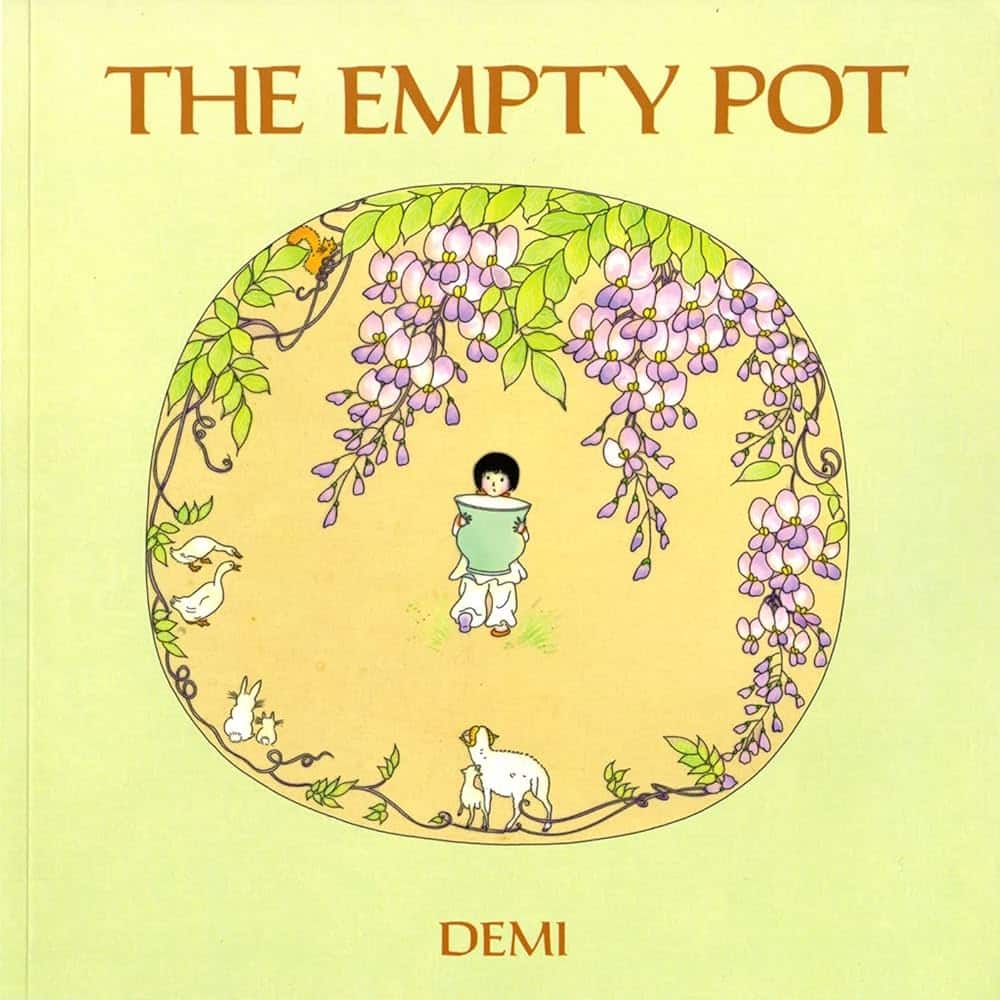
The Empty Pot by Demi
Imagine being told you could become the next emperor! All you need to do is grow the most beautiful flower. Easy, right? Not for Ping—his seed won’t grow no matter how hard he tries!

The Emperor’s New Clothes by Diane Namm
Two tricksters convince the emperor they are making him beautiful new clothes that are invisible to fools.
You must be logged in to post a comment.