


Pinocchio Play Guide
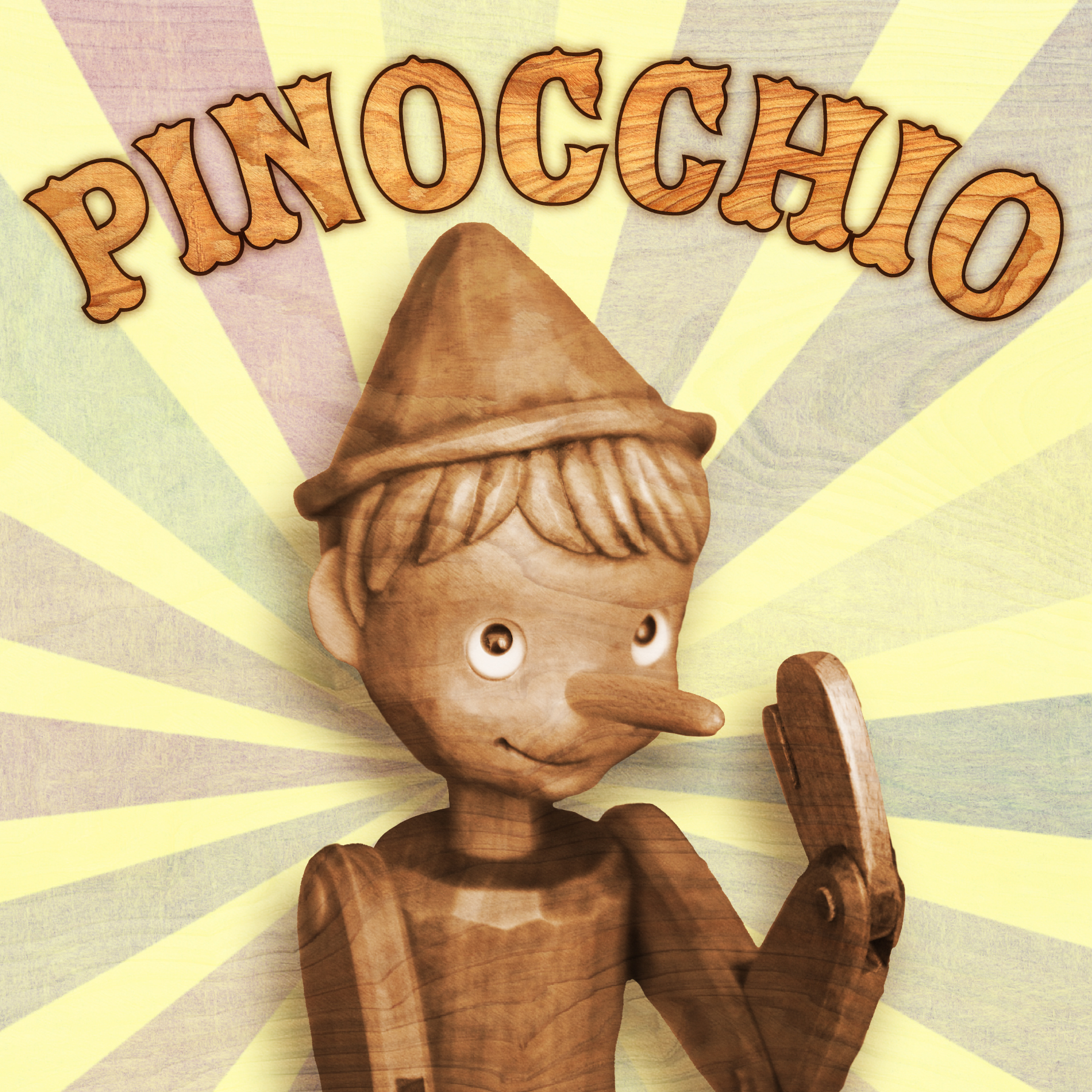
WHAT TO KNOW BEFORE THE SHOW!
PLOT SYNOPSIS

Geppetto is an old man with only one friend, a little cricket. One cold day, in an attempt to warm himself, he grabs the final piece of firewood when something bizarre happens: it begs to be spared from the fire. Perplexed by this sentient piece of wood, Geppetto decides to carve it into a little wooden puppet boy, whom he names Pinocchio, to warm his heart and keep him company on the cold days.
It isn’t long before Pinocchio understands that he isn’t the same as those around him as he is very clumsy, ill-mannered, and naive. He wishes he were a real boy, but he understands that he must first learn the ways of the world if he wishes to be real. His papa supports his desires and sells his only winter coat to supply Pinocchio with a schoolbook.
On his way to school, Pinocchio gets distracted by a sign for a puppet show. He decides to trade his new schoolbook for a ticket. During his time at the show, he meets Judy, Punch, and a showman who tells him that a puppet without strings would be a star attraction! Sure enough, Pinocchio’s act is a hit, but he doesn’t want to be a star. He wants to be a real boy. Unhappy with this, the showman locks Pinocchio away. He pleads with the man to let him go, and tells the showman about the poverty he and his papa are living in. Moved, the showman releases Pinocchio and sends him on his way with five gold coins.
However, Pinocchio doesn’t make it far as he runs into a fox and a cat–two con artists–who convince him that they can turn his coins into endless riches. They trick Pinocchio, tying him to a tree to freeze in the cold, but they only escape with a single coin. Luckily, the Blue Fairy appears and brings a freezing Pinocchio medicine to heal him. Once recovered, the Blue Fairy asks why he did not go to the schoolhouse as he had promised. He lies, stating that he could not find it. This lie causes Pinocchio’s nose to grow 12 inches! She tells him that his nose will grow when he lies and return to its standard size when he is honest. She then sends him home to his papa.

Meanwhile, realizing that he had been gone much too long, Geppetto goes to search for Pinocchio at sea. Pinocchio spots his papa on a boat in very rough waters, eventually causing it to overturn, resulting in his perceived death. Pinocchio mourns, deciding to honor his papa’s final wish for him to go to school.
At school, Pinocchio makes a friend named Lampwick who convinces him to leave for a fantastic place called Playland where there are only happy days. But too many days of pleasure leave the two feeling lazy turning Pinocchio and Lampwick into donkeys! Pinocchio attempts to flee by jumping into the sea where a fish nibbles away all of his donkey features. But just as soon as Pinocchio thinks he is free, he is swallowed by a whale!
In the belly of the whale, Pinocchio fears he is alone until he finds his papa, Geppetto! They decide to tickle the whale which causes the whale to sneeze, sending the two flying out of his mouth! Gepetto is very weak upon getting to shore. Pinocchio works hard to get ten water buckets from an older man to get his papa milk, which saves his life. This act of bravery, selfishness, and love turns Pinocchio into a real boy!
PLAY BEFORE THE PLAY
HUMAN PUPPET THEATRE

Pinocchio is a wooden puppet who longs to be a human boy. The way a marionette puppet moves is different than how we as humans move. This activity will allow your students to explore what it would be like to move as a puppet.
Start by putting your students in pairs. One student will become the puppet while the other will act as the puppeteer controlling the puppet. Ask the human puppets to imagine they have strings tied to their hands, head, and feet like a marionette. The puppeteers will pretend to hold those strings allowing them to control their puppet. (Note: If your students struggle with imagining the strings, you can first start by loosely tying yarn around their wrists or asking the puppeteers to use their voice to give instructions to their puppet. Once they get the hang of moving, you can remove the strings or instructions so both the puppet and puppeteer are pantomiming their action.)
Allow the pairs to explore how a wooden marionette puppet might move with the puppeteer guiding the movements of their puppet. As groups grow more comfortable, have your students explore daily human actions such as dancing, getting ready for bed, making a sandwich, etc. Ask students to consider incorporating different emotions of challenges that humans would face and exploring them as a wooden puppet. Students can then create their own short “day in the life scenes” with their puppets to share with the class. Once the first puppeteer and puppet are done, have them switch roles so everyone gets a chance to puppeteer and be the puppet.
KAS: TH:Cr1.1.3.a; TH:Cr1.1.3.c
THE GREAT DEBATE
In LCT’s production of Pinocchio, our puppet boy protagonist finds himself in some trouble when he listens to his new friend Lampwick who encourages Pinocchio to ditch school and go to a place called Playland. It’s there that Pinocchio learns a valuable lesson about consequences and the importance of making positive choices. In this activity, your students will be presented with a chance to make choices of their own.
Designate two sides of your classroom and choose two students: one to be the cricket and the other to be the mule. Using the sample chart below, give the cricket a statement from the cricket side and a statement from the mule side to the mule. You are also free to come up with statements of your own.
| CRICKET | MULE |
| Go to school and learn | Skip school and play |
| Do your homework as soon as you get home | Save your homework for the last minute before bed |
| Tell the truth and face the consequences | Tell a lie to avoid the consequences |
| Turn in a $10 bill you found | Keep the $10 bill for yourself |
| Go to bed on time | Stay up late |
| Eat healthy snacks | Only eat candy |
| Practice a tough skill | Give up because it’s hard |
| Help someone being picked on | Pretend you didn’t see anything |
| Ask for help when you need it | Stay silent so no one knows or sees you struggling |
| Save your money | Spend your money immediately |
| Walk the long, safe way home | Take a potentially dangerous shortcut |

Allow both the cricket and the mule a chance to convince their classmates to come to their side of the room. For instance, if the cricket’s statement is “eat healthy snacks,” they might try to convince their classmates to come to their side by talking about how healthy snacks give you energy to play. The mule might have the statement “eat only candy” and might try to convince their classmates to come to their side by mentioning how much fun it is to get candy at Halloween, especially full-size candy bars.
After listening to the initial arguments, allow the rest of your students to choose which side they want to go to. Once everyone has chosen their side, allow the cricket and the mule to give their rebuttals, trying to convince students to come over to their side. Take a final count to see which side wins the debate, then rotate roles so that every student has a turn as the cricket or the mule.
Once everyone has had a chance to lead the debate, ask your students the following questions:
- Which choices felt easy or hard?
- How does making decisions, whether right or wrong, affect yourself and those around you?
- Which arguments were most convincing?
- Did anyone change sides after listening to someone’s argument? What was said or done to change your mind?
KAS: 1.5.1; RL.4.4
CRICKET’S RIDDLE AND REBUS PUZZLE CHALLENGE
Use the link below to download the Riddle and Rebus Puzzle packet.
Begin with the Guess the Cricket’s Riddles worksheet. Students can work independently or with a partner to solve the Cricket’s tricky clues.
After everyone solves the riddles, divide your class into 3 or 4 teams. Have each team choose a “first challenger” to come to the front. Reveal a rebus puzzle—a picture-word puzzle that hides a secret phrase—from the packet. The moment you show it, the race is on: the FIRST student who correctly shouts the answer earns a point for their team! If students struggle, allow them to phone a friend or talk to their teammates to figure out the answer. Rotate through teammates so everyone gets a turn at the front.
You can find the answers for both the riddles and rebus puzzles below:
RIDDLE ANSWERS
- Trouble
- A nose
- A staircase
- 11 T,H,E,A,L,P,H,A,B,E,T
- Mississippi
- So that he has sweet dreams
REBUS PUZZLE ANSWERS
- Forget it
- Try to understand
- Travel overseas
- Read between the lines
- Downtown
- Eye shadow
- Stepfather
- Once upon a time
- Potatoes
- 3D movie
- Top secret
- Jack-in-a-Box
- Somewhere over the rainbow
- Blood is thicker than water
- First aid
- One in a million
- Apple pie
- Ice cube
- 6 feet under ground
- For once in my life
KAS: L.2.4; L.2.1
FOLLOW YOUR DREAMS
Everyone has their own hopes and dreams just like Pinocchio. Click the link below and print the Wish Journey Writing Adventure worksheet for each of your students. Have them answer the questions about their biggest dream/goal then right a short story about what they can do to accomplish their goal in the future.
KAS: C.2.3; L.2.1
CONTEXTUAL ARTICLE
THE AMAZING WORLD OF PUPPETS!
Did you know puppets have been around longer than movies, television, and even books? People all over the world have used puppets to tell stories, make each other laugh, and bring characters to life for thousands of years. And the coolest part? There are so many kinds of puppets—big, tiny, silly, spooky, and everything in between! Let’s jump into the magical world of puppetry and explore how these incredible performers work!
Puppetry and Its Place in History
The word puppet comes from the Latin word pupa, meaning “doll.” People have used puppets for thousands of years for ceremonies, rituals, entertainment, education, and more. Every culture has added its own style from funny characters and mysterious shadows to colorful costumes and intricately carved wooden heads. For instance, Bunraku puppets in Japan are large, beautifully costumed puppets that take three puppeteers to control. Europe’s most famous puppet duo—Punch and Judy—have been making audiences laugh since the 1600s with silly slapstick humor. And right here in the United States, Jim Henson brought puppetry back into the world of television by creating characters (the Muppets) that millions still know and love like Kermit, Miss Piggy, Big Bird, and Elmo!

The Many Types of Puppets
Hand Puppets: Tiny Actors on Your Hands
Hand puppets involve a puppeteer slipping their hand inside the body of the puppet and using their fingers to manipulate and bring the puppet to life. Simple hand puppets are easy to make and move, but hand puppets come in a variety of styles and sizes. Some lack legs and may be nonarticulated (meaning they lack a movable mouth) while others are incredibly intricate with full bodies, fully functional heads, and require multiple puppeteers to manipulate.
Rod Puppets: Smooth Movers
Rod puppets are controlled thanks to long sticks called rods. One rod holds up the puppet’s body and head, while smaller rods help move the arms and sometimes legs. That makes rod puppets feel more lifelike. Rod puppets are popular in countries like Poland, Hungary, and Romania, where big puppet theaters put on huge performances.
There are some puppets called hand-and-rod puppets that utilize both puppetry styles. Jim Henson used hand-and-rod puppets to bring characters like Kermit the Frog to life.

Shadow Puppets: Stories in Silhouette
Shadow puppetry is among the oldest forms of puppetry in the world. Shadow puppets are usually flat and decorated with cut-out patterns though there are three-dimensional shadow puppets as well (like the wayang golek puppet theatre form of West Java). Puppeteers hold the puppets up between a screen/wall and a light source (such as a candle or flashlight) so audiences see the puppet’s shadow dancing across the surface. Shadow puppetry is popular in places like China, Indonesia, Thailand, India, Greece, and Turkey. With just shadows and imagination, these puppets can create entire worlds. Monsters can grow bigger by moving closer to the light; heroes can shrink away by stepping back.
Marionettes: The Masters of Movement
Marionettes hang from strings and are controlled from above. Their bodies are typically made of wood, and the various parts can move with a gentle pull of a string. A classic marionette might have strings attached to the hands, legs, shoulders, head, and back. That means marionettes can dance, bow, walk, and even do fancy tricks, all at the whim of the puppeteer. Marionettes are among the most challenging puppet types to control but also some of the most magical to watch.
In Conclusion: Puppets are Awesome
Puppets can do anything you can imagine. They dance without getting tired, grow big or shrink small, fly through the air, or turn into magical creatures. They can help education audiences and pass down cultural lessons or just make people giggle until their sides hurt. And best of all? You can become a puppeteer anytime you want. All you need is your creativity, your hands, and a character ready to spring to life.
HOW TO GROW AFTER THE SHOW!
EXTEND THE EXPERIENCE
FROM THE SHADOWS

In this activity, students will create a shadow puppet show by acting out scenes with puppets in a shadow box theatre. Begin by making the puppet theatre and the puppets following the instructions below.
Materials Needed:
- Cardboard box
- Puppet sheet printed on cardstock
- Parchment paper
- Scissors
- X-ACTO knife
- Tape
- Dowel rods
- Flashlight
To make the shadow puppets, you’ll first need to print the shadow puppets from the link above. Secure the shadow puppets to dowel rods using tape.
Instructions for Creating the Shadow Puppet Theatre:
1. Assemble a cardboard box.
2. On the front side of the box, cut out a large square using an X-ACTO blade. Once this is cut, measure out a piece of parchment paper slightly bigger than the square you’ve cut. Secure the parchment paper to the inside of the box with tape to make your screen.
3. On the opposite side, cut a small hole to secure your flashlight in.
4. On the remaining two sides of the box, cut out two smaller squares so you can put your hands and puppets inside.
Once your theatre and puppets are complete, show your students how to use them by acting out a brief retelling of “Pinocchio.” The bolded words have a corresponding puppet you can use to tell the story. As you act out the story, encourage your students to focus on the story’s plot (beginning, middle, and end), characters, and setting.
“Once upon a time, there was an old, poor man named Geppetto whose only friend was a cricket. The older man carved a little wooden puppet boy named Pinocchio. Pinocchio’s only wish was to be a real boy. The cricket told Pinocchio he must gain knowledge at school. On his way, Pinocchio was distracted by a puppet show and met the Showman, who locked him in a cage. After Pinocchio was released, he ran into two con artists—a fox and a cat—who stole his coin by tying him to a tree. Freezing, Pinocchio was hopeless until the Blue Fairy came. When she asked why he was not at school, he lied, and his nose grew a foot long! She told him to go back home to his papa, but he saw his father’s boat overturn and sink into the sea. He decided to go to the schoolhouse to honor his father’s last wish, but was persuaded to go to Playland, where he grew incredibly lazy and turned into a donkey! He fled by diving into the sea, only to be swallowed by a whale. Inside the whale, Pinocchio found his father! They tickled the whale, which caused him to sneeze, sending them flying! This act of bravery, selfishness, and love granted Pinocchio his one true wish: to be a real boy. The pair then lives happily ever after.”
Now that you have acted out the story, inform the class they will create their own puppet show. They will use the puppets from the original story but can change them in any way to create a new one. Divide your class into small groups. Have each group work together to create a story that focuses on plot, character, and setting. Students should write down their story which will be used to help narrate their final performance. Allow each group the chance to practice their story before having them use the shadow theatre to act out their story for their peers.
Once all groups have performed their short stories, ask the class the following questions to reflect on the experience as a group:
- What was the most challenging part of performing the play?
- What went well during your group’s process?
- How did you work together as a team?
- What was the most fun part of this activity?
KAS: TH:Pr5.1.2.a; TH:Pr4.1.3.a
PASTA PUPPET OF EMOTION
Did you know puppets are a great way to help students explore emotions? Gather your students and have them walk around the classroom as they normally would. Then ask them to walk as if they are feeling different emotions (happy, sad, angry, hungry, excited, etc.). As they move around the space, ask your students to consider how their bodies (arms, legs, and head) move as they shift emotions.
After completing the “emotional walk,” inform your students that they will translate their newfound understanding of how their bodies move into puppetry. Each student will need the following materials to make their pasta puppets:
- 10 macaroni pasta noodles
- 2, 12-inch white pipe cleaners
- 1, 1-inch round wooden bead
- 5 to 8 small wooden beads
- 1 chopstick, dowel rod, or pencil
- White medium elastic cord, 8 inches
- Black thread or thin elastic cord, 25 inches
- Black Sharpie
To assemble the pasta puppets, follow the instructions found here: https://www.handmadecharlotte.com/35832/
Once your class has finished their puppets, revisit the “emotional walk,” but this time, have your students do the various movements with their puppet to see if they can find ways to translate their emotions into a lifeless object and bring it to life.
Extend the Experience: have your students play a version of charades with their puppets: one student draws an emotion from a bag and performs it with their puppet for the rest of the class to guess.
KAS: TH:Cr1.1.K.b; TH:Pr5.1.2.a
THE NOSE THAT GROWS
Pinocchio learns a hard lesson about why lying is wrong. This activity encourages students to understand why honesty is the best policy by trying to guess who is lying!

Have your students sit in a circle. Choose one student to be the guesser. They will sit in the middle of the circle to start with their eyes closed. Have everyone else in the circle make two fists in their lap. Hand a button or other small, quiet, easily hidden object to one of the students in the circle. Instruct the student in the center to count to 20 out loud with their eyes still closed. During the time of the counting, the student with the button will pass it to the next person, on and on until the student in the middle finishes counting. Before the student in the middle can open their eyes, they must ask, “Ready?” allowing the students in the circle to ensure the button is properly hidden and everyone is ready to go with their closed fists in their lap. Once everyone is ready, have the student in the middle stand up and ask each person, “Do you have the button?” Each student will answer, “No, I do not have the button.” The guesser will then try to guess who the liar is that is holding the button. If the liar is correctly guessed, then the student in the middle wins. If not, the button holder wins.
Play this a few times before moving to the next level of the game. Everything is the same as before with the guesser in the middle and the button passing from person to person. However, this time, when the guesser asks each student, “Do you have the button,” each student, including the person with the button, has the choice of responding, “No, I do not have the button” or “Yes, I do have the button.” The guesser will then have to determine who really has the button.
After playing this game, ask the group to reflect on dishonesty and trustworthiness. Some questions you can ask for a guided discussion are:
- Are there ever “good” reasons to lie? What are they?
- What’s the difference between a harmless “white lie” and a harmful one?
- Why do people lie (e.g., to avoid trouble, to protect feelings, for fun)?
- How does lying affect trust between people?
- Do you notice any physical signs in yourself when you lie (like speaking faster, looking away, fidgeting, etc.) similar to how Pinocchio’s nose grew?
- Why did Pinocchio lie to the Blue Fairy about why he didn’t go to school?
- How can you tell if someone is lying (beyond a growing nose)?
- What can we do to rebuild trust?
After the discussion, it’s time to rebuild the group’s trust. Ask your students to line up and hold hands. Instruct everyone to shut their eyes and keep them closed throughout the entire activity. You as the teacher will hold the hand of the first person in line and help lead the group around the classroom (once you have ensured the safest path with the most space). You can have different students lead the line and try their hand at getting everyone from point A to point B. Encourage students to communicate with one another to help them move safely. The goal is to trust one another and guide each other through the space.
After engaging in the trust-building activity, ask the class to reflect on the following discussion questions:
- Were you able to keep your eyes closed the entire time?
- If yes, what made you feel safe enough to do so?
- If not, why not?
- Did you receive help from anyone in the group? Did you help anyone?
- What could people do to help you feel comfortable trusting them to guide you?
KAS: K.I.UE.2; 5.5.5
PUPPET CROSSWORD
Click the link below and print the activity for each of your students to test their Pinocchio crossword skills!
KAS: L.4.4a; L.6.4a
SUGGESTED READING
If you like timeless tales, you might also like…
The Adventures of Pinocchio by Carlo Collodi
When the old woodcarver Geppetto carves a puppet out of a talking piece of wood, his creation can dance, sing, and do somersaults–but is also very naughty and disobedient.


Alice in Wonderland by Lewis Carroll
Follow young Alice as she falls down a rabbit hole into a bizarre world of eccentric and unusual creatures.
The Wizard of Oz by Frank L. Baum
When Dorothy is whisked away by a cyclone from her Kansas farm, she finds herself in the land of Oz, home to the Tinman, Scarecrow, and Cowardly Lion.


The Little Prince by Antoine de Saint-Exupéry
An aviator whose plane is forced down in the Sahara Desert encounters a little man from a small planet who recounts his adventures in search of what is truly important in life.
5-Minute Classic Short Stories by Disney Press
From Pinocchio to Stitch, everyone’s favorite classic Disney characters are featured in this storybook!
