The Legend of Sleepy Hollow Play Guide
WHAT TO KNOW BEFORE THE SHOW!
PLOT SYNOPSIS
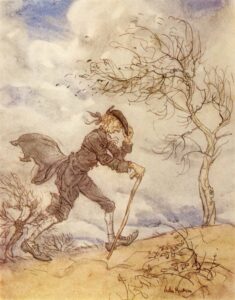
Sleepy Hollow is a town of mystery, plagued with rumors of ghosts, ghouls, and a Headless Horseman. It is quite the contrast to its new school master. Lanky and tall, Ichabod Crane is different from the rest of the town. He is more interested in the sophisticated things in life such as writing, reading, and singing. Because of this, he is quite popular with women.
Brom Bones is described as always ready for a fight, and he takes a particular dislike for the school master. Brom tells Ichabod that Sleepy Hollow is crawling with legends and that the very bridge Ichabod has to cross to get to the school house is their resting place. Brom tells him if you successfully cross the bridge, then the frightening voices and strange visions would disappear.
Despite Ichabod’s fears of ghosts, there is a creature that strikes even more terror in him: a woman. Katrina Van Tassel is beautiful and the daughter of a wealthy farmer. Ichabod isn’t the only one to notice Katrina’s beauty. Brom also has his eye on her. She flirts with both men, leading them both to compete for her attention. She tells Ichabod how sophisticated and civilized he is. Meanwhile, she tells Brom how special he is to her and invites him to her father’s Halloween Frolic.
Preparing to travel to the Halloween Frolic, Ichabod visits Han Van Ripper and asks for his finest steed. Instead, Ichabod is given Gunpower–a clumsy and shaggy horse. Ichabod arrives at the party and asks Katrina for a dance. Brom enters the party in a rage when he sees the two of them. He cuts into the dance, and steals Katrina away. Katrina is moved by this gesture, stating that this must prove that he truly cares for her. She exits the party, departing with a kiss and flirtatious glance to both Brom and Ichabod.
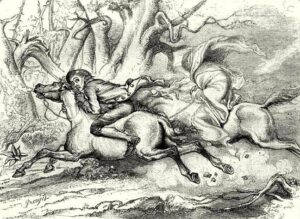
As the night begins to wind down, the remaining party attendees gather around the fireplace to exchange ghost stories of Sleepy Hollow. Ichabod hangs on to every word as Brom shares the legend of the Headless Horseman. Brom says he was a German trouper during the Revolutionary War who met an untimely end when his head was carried away by a cannonball. Frighteningly, Brom shares that the Horseman resides on the church’s bridge at night. He reminds Ichabod that he would be safe if he successfully crosses the bridge.
Traveling through the night, Ichabod becomes paranoid. He provides a swift kick to Gunpowder to make him move quicker. This causes Ichabod to fall off his frightened horse, leaving him in the darkness. In the shadows, he begins to see a figure take shape: the Headless Horseman!
The next morning Gunpowder is found but with no school master in sight. Instead, Ichabod’s hat and a shattered pumpkin head are found near the bridge. The townspeople can only conclude Ichabod had been taken by the Headless Horseman.
PLAY BEFORE THE PLAY
HAUNTING HISTORIES: UNEARTHING LEGENDS & LORE
For this activity, divide your class into groups of 4-5 students and assign them one of the following topics:
- The History of The Legend of Sleepy Hollow
- The Origins of the Headless Horseman
- Comparing/Contrasting Legends from around the World (e.g. – The Dullahan, The Wild Hunt, La Llorona, Baba Yaga, etc.)
- Superstition and Folklore in Everyday Life (e.g. – Crossing your fingers, black cats crossing your path, Friday the 13th, knocking on wood, etc.)
Have each group conduct research on their topic making sure to answer questions about origins, symbolism, characters, themes, impact, etc. Groups should present their findings in the form of Google Slides, poster board, or some other visual medium. Together, each group’s project will help form a classroom “Legend of Sleepy Hollow Museum” where students rotate through stations to learn from one another.
Afterward, bring the class together for a discussion using the questions below to connect what they’ve learned about legends, folklore, and history to the themes of The Legend of Sleepy Hollow.
Discussion Questions:
- How do legends and folklore reflect the fears and values of the people who tell them?
- Why do some stories, like the Headless Horseman, continue to capture our imagination today?
- How can research help us understand stories before we see a performance?
KAS: 3.H.CH.1; 3.I.UE.2; 4.I.UE.3
GALLOP WITH THE GHOST: BECOMING THE HEADLESS HORSEMAN
Bringing a headless horseman to life onstage is no easy feat. Have your students use their creativity and imagination to try their hand at moving and thinking as the headless horseman. Start by having them find their own space in the room then read the narrative below:
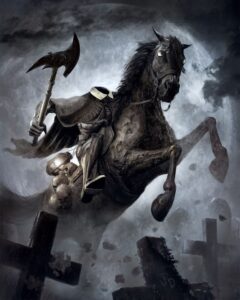
Close your eyes for a moment and imagine your head is too heavy to carry…or maybe it’s missing entirely. Now, open your eyes and stagger forward, feeling your balance shift as you move blindly through the mist. Let your shoulders roll back, making your body loom tall and terrifying over the trees. Swing your arms like a flowing cloak—sometimes soft and whispery, sometimes whipping violently as if chasing something. Grip the invisible reins of your horse or the fiery pumpkin that is your head in your hands and lunge forward, imagining you are hurling it at anyone foolish enough to cross your path.
Now, shift to your legs. Stomp the ground like powerful hooves, then tiptoe silently through the fog. Feel the difference in the weight of your steps—the stomp is terrifying, the tiptoe is sneaky, almost ghostly. Lean your torso forward and twist slowly from side to side, scanning the shadows. Then burst into a sudden gallop, racing through the forest. Jump, leap, and lunge, stretching your movements to fill the space. Remember: your whole body is part of the hunt—from your fingers curling like claws to your toes gripping the earth.
Experiment with levels: crouch low, sneak along the ground, then rise tall and towering above the others. Shift your pace: move slowly and creepily, then charge suddenly and powerfully. Pause and freeze like a statue waiting to strike, then vanish into the shadows as if you are smoke fading away.
Now, move around the space freely, combining all of these elements. Be the Headless Horseman—powerful, eerie, unpredictable, and unstoppable. Play with your own choices: when will you sneak? When will you stomp? When will you leap or disappear? Let your imagination guide the hunt.
KAS: 5.1.L1.; TH:Cr3.1.7.c
THE HOLLOW HAUNTED STUDIO: A LESSON IN THEATRE OF THE GROTESQUE
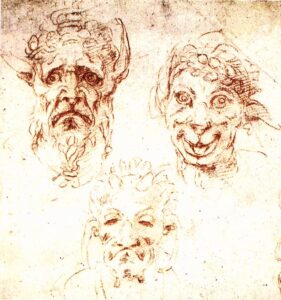
Theatre of the Grotesque was an Italian dramatic movement that saw its height from 1916 to 1930. The movement placed emphasis on the painful laughter that comes from the tragedy of life’s most absurd and surreal moments and is categorized by exaggerated facial expressions and physicality.
For this activity, your students will explore the physicality of Theatre of the Grotesque by creating their own characters and collaborating to perform a short ghost story. Begin by guiding your students through the Theatre of the Grotesque Movement and Facial/Vocal activity below:
- Move around the space like your head is a giant pumpkin pulling you side to side.
- Creep through the room like your spine is twisted and crooked, making your steps uneven.
- Sway through the space like you’re a scarecrow stuck on sticks, blowing in the wind.
- Shuffle like you’re a stitched-up doll, stiff and jerky, until a body part “falls off.”
- Sink and stretch like melting candle wax, dripping lower and lower with each step.
- Tangle yourself up like your legs are tree roots twisting and tripping as you try to move.
- Make your angriest scowl… but add a silly, squeaky pout. – Say in a high-pitched squeak: “Don’t make me ANGRY… or else!”
- Open your mouth like you’re about to scream, but instead just whisper. – Whisper-shout: “I’m scarier than you think!”
- Make your eyes HUGE and shocked, but grin like you’re thrilled. – Say in a slow, creaky voice: “I know a secret…”
- Puff your cheeks like a pumpkin ready to burst. – Let air out slowly and say in a deep rumble: “I’m going to roll riiiiight over you…”
- Make your saddest crying face… but laugh as you speak. – Say through giggles: “I’m not sad… really… ha ha ha!”
- Clench your teeth and chatter like you’re freezing, but make your eyes fiery. – Say in a stuttering growl: “Y-y-y-you can’t escape me…”
- Make the silliest face you can (crossed eyes, tongue out, etc.). – Say in a serious ghostly tone: “I am the Headless Horseman… fear meeee.”
Now have students create a character. Encourage them to name their character, pick an age, choose defining personality traits, and explore their character’s backstory and physical movement/vocal traits. Then divide your students into groups of 2–4 to create a scene of a short ghost story that includes all their characters. Encourage students to have a clear beginning, middle, and end. Let each group practice their scenes before performing them for the class.
KAS: Cr2.1.6.b; TH:Cr3.1.7.c; C.5.3
INTO THE HOLLOW: A LEGEND COMES ALIVE
Divide your students into small groups and give them copies of the packet found below to allow them a chance to design a spooky board game!
Students will name their game, plan the board path, brainstorm cards (events, challenges, or story prompts), and write out the rules, including how to move, special conditions, and how to win. Once finished, groups will exchange and play each other’s board games.
KAS: VA:Cr1.1.6; VA:Cr1.1.3; VA:Re9.1.3
CONTEXTUAL ARTICLE
FROM PAGE TO STAGE: SLEEPY HOLLOW THROUGH THE EYES OF A DIRECTOR
We sat down with Heather Branham, director of Lexington Children’s Theatre’s production of The Legend of Sleepy Hollow, to talk about her thoughts, inspirations, and artistry for the show!

What is your directing process for a show? How do you start, plan, and bring everything together?
As casting director for a show, my process starts almost a year before the first performance. I read the show and figure out how many and what kind of characters are needed according to the script. I attend large theatre conferences in our region to see hundreds of auditions, then I hire and cast the actors best-suited for our production.
Meanwhile, our designers and I scour the text for clues of what we’ll need for the set, costumes, props, and sound. We have a series of design meetings and production meetings to work out the details and then rehearsals begin. We have about three weeks for our professional touring productions to rehearse and explore blocking and characterization before bringing the show to students! That’s where the real adventure and fun begins!
How do you create the world of Sleepy Hollow and bring the Headless Horseman to life on stage in a way that’s scary but fun for students?
As a director, my main concern is to represent the playwright to the best of my ability while adding a directorial vision that deepens the world they created. For our production, we played with a style called “Theatre of the Grotesque” which isn’t as “gross” as it sounds. We use this style to juxtapose funny, big characters with moments of light horror to evoke the “painful laugh” that the grotesque style brings. During rehearsals, the actors work to find ways in each character to exaggerate their emotions, expressions, body positions, and voices. In theory, this technique should emphasize goofy, silly, physical comedy that gets the audience laughing comfortably then brings about sudden shrieks, jumps, and discomfort in the spooky scenes.
We also use several technical elements to aid our storytelling. When we perform for schools, we don’t bring lighting with us. This creates a unique challenge for our design team to build a spooky environment in broad daylight! From the start of our design process, this has been a main focus. Instead, we dreamed up elements of spectacle in the costumes, props, sound and set that didn’t rely on lighting to be spooky or give the audience a creeped-out feeling. I don’t want to give too much away – the element of surprise is our best friend in this production – but it would be fun to see how many spooky theatrical elements the audience can recall after the show.
What are the biggest themes of the show, and how do you make them clear to students?
Some of the biggest themes are the power of folklore to bind a community together, the role of greed, fear, and ambition throughout humanity, and the clash between “cultured” city-folk vs. the “natural” rural farming community.
We layer these themes into the production’s design and performance choices. We play with color and fabric with the costumes of the fancy, city fellow Ichabod versus the more toned-down natural colors of the rural folk. In the set, Gabriel Slusser’s design of the Church Bridge is portrayed as a threshold to the schoolhouse with natural branches atop our set panels. This threshold is the place where culture and nature collide: the realm of the supernatural. The acting choices are fueled by dark human traits that drive each character and supply their motivations.
What does Ichabod learn on this adventure, and why is that important for the story?
In the original story, and in Theatre of the Grotesque stylization, none of the characters learn to be better people. Characters usually have an arc and learn something. In this one, though, they all have selfish motivations that clash with each other. Maybe that is why the township of Sleepy Hollow harbors so much superstition and distrust of outsiders who want to change their way of life. Further, maybe this is why the outsider Ichabod (a city fellow trying to culture the country folk) is the object of so much scorn and distrust among the Sleepy Hollow community.
Which character in the show do you think is the most interesting or tricky to direct, and why?
They are all such exaggerated, fun characters to play with, but the actors have a big job in that most of them play multiple characters. While Ichabod is probably the best known, second only to the horseman, it is actually the storytellers and supporting characters that are the trickiest! They have to be built from very little textual support, and so much work in our rehearsals was spent in developing names, backstories, physicalizations, obsessions, and personality for them.

What is your favorite scene in the show, and what makes it special to you?
That’s like trying to choose my favorite child! Each actor is amazing and does something special to bring each character and the story to life. As an observer, I really enjoy watching Cameron Taylor play Ichabod. As all the other actors have the joy and burden of playing multiple characters, Cameron gets to dive deep into Ichabod Crane as the hinge-pin for the show. He is well-educated and experienced in both dramaturgy and physical acting styles like Commedia Dell’arte. Because of his training, he’s brought so much insight and history into rehearsals and his acting choices. I just have to suggest where to enter and exit and watch him go!
What do you hope students take away from watching this show?
This show has so much to offer students, families, and teachers alike. Lexington Children’s Theatre often picks shows from a literary source to produce. As this is an adaptation of the original story by Washington Irving, we get to share this old story to a new generation so it doesn’t get lost in the noise of so many entertaining options of our contemporary world. This is a story young audiences can share with their parents, grandparents, and even great-grandparents as a source of common ground.
Why do you think stories like The Legend of Sleepy Hollow continue to captivate audiences today?
Between the well-written literary tale, the stories around a campfire, and the myriad of versions shown on stages and screens, the story will continue to delight us in the spookiest of ways. Similarly, this generation will be inspired to create their own tales that examine the supernatural and true nature of humankind.
How do you get in the spooky mood for Halloween?
I love the spooky season, so I use it as an opportunity to watch older scary from my childhood at home as well as new ones in movie theatres. It’s so fun to get scared in a dark room with other people all at the same time. That’s a major opportunity to scream from a well-placed jump scare, have my heart race from pulsing music of anticipation in the score, and then experience a “painful laugh” from the whole theatre after the scream has happened and we realize it’s just a movie. I have tried to supply this production with some of those same thrills for our audience.
HOW TO GROW AFTER THE SHOW!
EXTEND THE EXPERIENCE
LOST YOUR HEAD?

In America, it’s tradition to carve pumpkins (jack-o-lanterns) for Halloween. This vegetation-carving tradition began in Ireland with the legend of Stingy Jack. Stingy Jack is said to be a man denied entry into both heaven and hell and who now roams the Earth for eternity after tricking the devil. The practice was brought over by Irish and Scottish immigrants who would carve turnips, potatoes, and beets into frightening shapes to light with small flames to scare away spirits. Over time, Americans adopted this tradition but decided to use pumpkins instead as they were larger and more easily carved than the other vegetables.
In The Legend of Sleepy Hollow, the Headless Horseman lost his head when a stray cannonball carried it away during the Revolutionary War. The legend states that he replaced his head with a carved pumpkin. With the context of the history of jack-o’-lanterns and the story of Sleepy Hollow, ask your students to imagine a new kind of head for the Headless Horseman. Encourage them to think of an object that could be carved and lit from the inside. Do you think another object would have been more frightening? Or perhaps sturdier? Have students brainstorm and write or draw their ideas on a separate sheet of paper. Then assist students as they create a new head for the Headless Horseman using the instructions below:
Materials Needed for the Headless Horseman’s New Head:
- Recycled Milk Jug (emptied and cleaned)
- Black Cardstock
- Additional Embellishments (Yarn, Colored Construction Paper, Rhinestones, etc.)
- Scissors
- Glue/Tape
- LED Tea Light
How to Make the Horseman’s New Head:
- Brainstorm ideas for each side of the Headless Horseman’s new head. Feel free to sketch out your ideas so you have a plan to follow.
- Once decided, trace different facial features on black cardstock and cut them out.
- Attach the cardstock features to each side of the milk jug using glue or tape.
- Finish decorating the milk jug however you see fit (consider adding hair using yarn or rhinestones for freckles).
- Cut the bottom of the milk jug off and place the LED tea light inside to light up your new head!
KAS: VA:Cr1.1.3; VA:Cr1.1.6
THE SOUNDS OF SLEEPY HOLLOW
Foley art is the process of creating everyday sounds for film, television, and video games using a variety of props, materials, and surfaces. The noises made from these objects end up sounding like footsteps, rustling clothes, or the swish of a sword. These sounds are used to enhance the realism and storytelling of a production. In this activity, students will get to experience the process of creating Foley art for a scene from The Legend of Sleepy Hollow using items found within the classroom.
Start by dividing your class into three groups. Give each group the scene from The Legend of Sleepy Hollow and cue list found below:
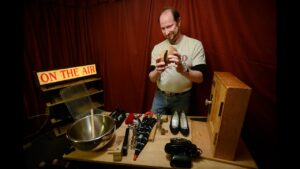
Divide the groups of three in half and decide who will begin as a performer and who will begin as a Foley artist. Once groups are divided, the students will read through the scene. As they read, have students list the different sounds that can be pulled from the text. Once their list is complete, welcome students to look around the classroom to find everyday objects that can be used to recreate the sounds they listed. Encourage them to think about the ways their bodies might move during the scene and how the sound will be affected by this movement. Remind them one of the goals of Foley is to sync up the sounds with the movements. Give them time to practice before performing for their peers. Then have the Foley artists become the performers and the performers become the Foley artists.
After everyone performs, discuss as a class what objects were used in different ways to create Foley art for the same scene. Ask your students what they found exciting and/or difficult when collaborating together as a group to create a performance using Foley art.
KAS: TH:Pr5.1.5.b; TH:Pr6.1.4; TH:Cr1.1.6.b
EMBRACING ENDINGS
At the end of the play The Legend of Sleepy Hollow, we discover that Ichabod Crane is nowhere to be found. All that is left is his hat and a shattered pumpkin. Ask your students to use their imagination to create their own ending to the story. Have them consider the following questions: What do you think happened to Ichabod? Do you think he was taken by the Headless Horsemen, or did he flee town? Was the Headless Horsemen even real or just a legend? You decide! Have your students write their new ending to the story on a separate sheet of paper before sharing with the class.
KAS: C.7.3f; C.5.1e
WHAT’S IN A WORD?
Now that your students have seen LCT’s production of The Legend of Sleepy Hollow, test their knowledge of the story by printing out the crossword activity below:
KAS: L.4.4a; L.6.4a
SUGGESTED READING
If you like frightening tales and legends of old, you might also like…
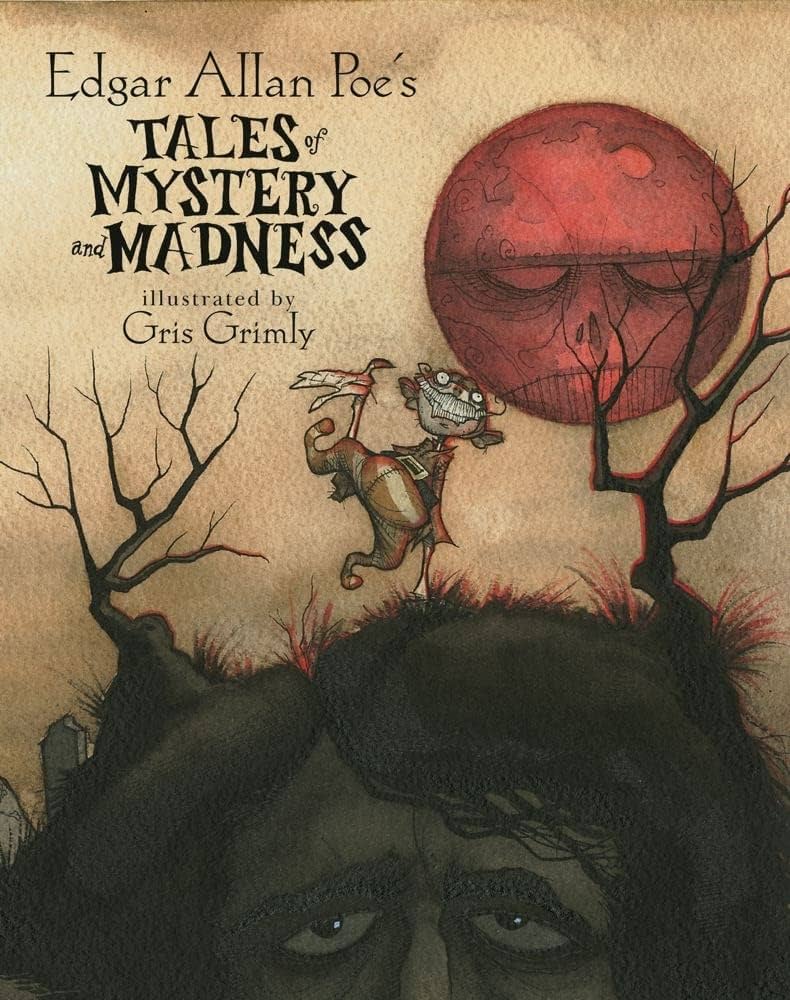
Edgar Allan Poe’s Tales of Mystery and Madness by Edgar Allan Poe
Enter a world where you will be shocked, terrified, and thrilled. Features several stories by the master of woe, Edgar Allan Poe: The Black Cat, The Masque of the Red Death, Hop-Frog, and The Fall of the House of Usher.

Pinocchio by Carlo Collodi
Carved by a poor man named Geppetto, Pinocchio is a wooden puppet that comes to life. He soon leaves his maker and commences a journey of misadventures.
Scary Stories to Tell in the Dark by Alvin Schwartz
Are you brave enough for scary stories? Welcome to the macabre world of Scary Stories, where folklorist Alvin Schwartz offers up the most alarmingly chilling collection of horror, dark revenge, and supernatural events of all time.

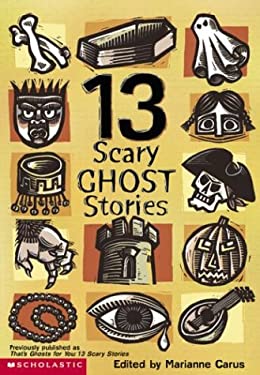
13 Scary Ghost Stories by Marianne Carus
Readers will meet thirteen ghosts, werewolves, skeletons, and other creepy characters in this spine-tingling collection of scary stories. In these tales, no place is safe. A ghost could appear in a crowded swimming pool, a sunny beach, or right in your own backyard!
In a Dark, Dark Room and Other Scary Stories to Tell by Alvin Schwartz
Shivering skeletons, ghostly pirates, chattering corpses, and haunted graveyards…all to chill your bones! Share these seven spine-tingling stories in a dark, dark room.